
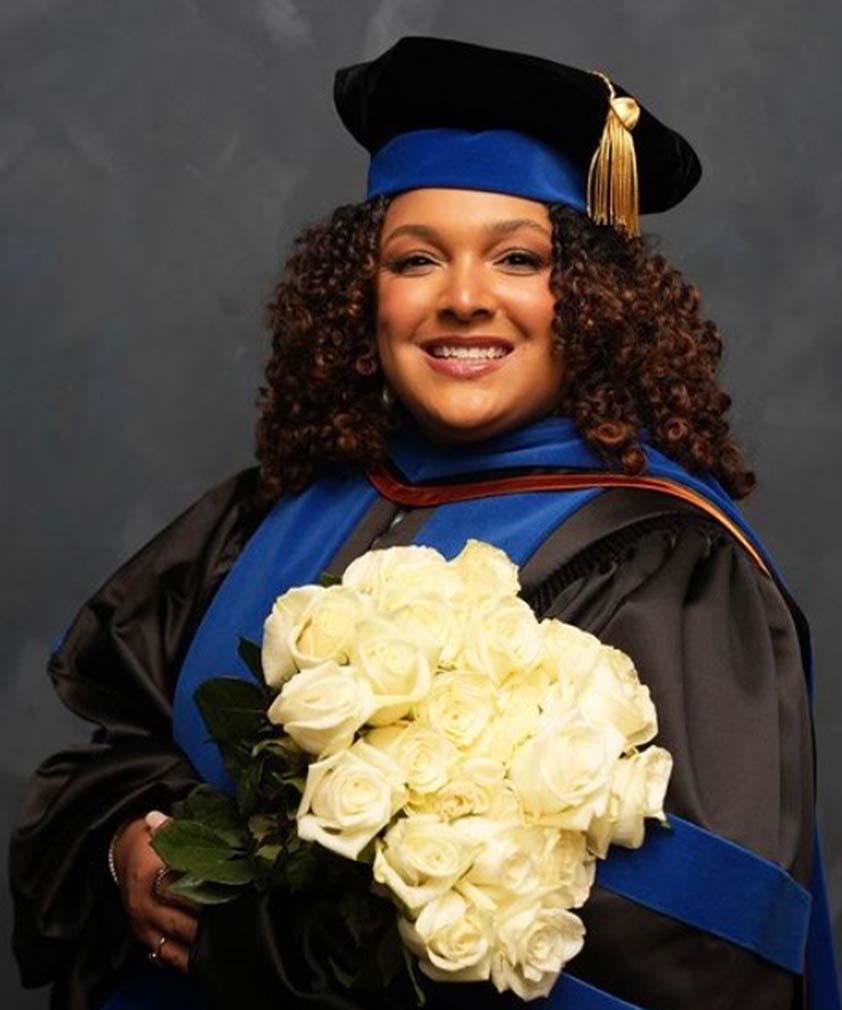
Morgan Foreman, PhD ’25 works for Children's Healthcare of Atlanta as the AI and Machine Learning Product Team Lead. After beginning her MS at McWilliams School of Biomedical Informatics in 2019, Morgan applied to the PhD program in 2020, began her studies in 2021, and earned her doctoral degree in Summer of 2025.
1. Where are you currently working, and what does your position require?
Soon after graduating, I joined Children's Healthcare of Atlanta, Georgia's sole pediatric health system, right here in my hometown. As the AI and Machine Learning Product Team Lead, I manage a team of agentic AI/ML engineers and data scientists building internal AI products aligned with our system-wide AI strategy. I draw on my previous experience as a Product Lead at IBM Research, along with the human factors and change management training I gained at McWilliams, to set milestones and align strategy as we turn early-stage AI tools into enterprise-grade products. I also lead workflow mapping to integrate these products effectively into our providers' daily work, and I make sure we're measuring whether our tools deliver proven outcome benefits. My dissertation work on culture and behavior change still guides how I approach every product: technology only creates value when the people using it are engaged, and when it's designed with the full diversity of the patients and families we serve in mind.
2. You started at McWilliams in the Master’s Program and transitioned to the PhD. Describe that decision and what encouraged you to apply to a higher-level degree within the school.
I came to McWilliams as a Master's Student, planning to decide near the end of the program whether a PhD in informatics was right for me. After taking BMI 5300 (Introduction to Biomedical Informatics) and getting to know more of the faculty, I knew I was going all the way, but I assumed I'd finish the master's first. At the time, I was a part-time remote student living in Boston and looking for a way to move to Houston before another winter set in. Then COVID hit in March 2020. My mom encouraged me to start the PhD sooner: none of us knew what would happen in the world, and if I was going to be home studying anyway, why not? I spoke with Academic Affairs, who agreed I'd be a good fit to roll my credits into the PhD. I applied by the end of June, moved to Houston at the end of August, and started my PhD in January 2021.
3. Which faculty member played an important role in your studies at McWilliams, and why?
How can I pick just one? The entire faculty and staff are so supportive. I'm one of those rare PhDs who would do it all over again if I could. I have to shout out two of my committee members. Dr. Amy Franklin let me focus my dissertation on a topic close to my heart and gave me room to work at my own pace while I was employed full-time, while still pushing me to stay on task and take my knowledge and theory to innovative depths. Dr. Angela Ross was like my auntie. Whenever a PhD milestone had me stressed, she gave me the best pep talks to keep me going.
4. Tell us about your dissertation topic. Explore the research focus and tell us what motivated you to highlight that area of study.
My dissertation developed a theory-informed framework called the Socio-Technical Model of Culture and Behavior Change. It combines the socio-technical model for Behavioral Intervention Technologies and the socio-behavioral Patient Activation Framework with culturally centered theories. The model guides informaticists and digital health experts, step by step, in developing digital health tools through a cultural lens.
My use case focused on the behavior change needs of Black pregnant women diagnosed with hypertensive disorders of pregnancy. I knew I wanted a dissertation that would directly benefit the Black community. Black women face the highest maternal mortality rate in the United States, and one of their most common concerns is feeling unheard by their providers. Through bedside interviews and a national sample survey with mothers, I found that digital health tools that increase motivation can help mothers become more involved in their own care. Mothers reported that they wished a tool existed with features like the examples I modeled with the framework. My hope is that this framework helps developers build tools that reflect the communities they serve, and it can be applied to other populations.
My interest in digital health grew out of my behavior change work at IBM and the digital health course I took with my committee member, Dr. Sahiti Myneni.
5. How is your PhD degree helping you achieve your professional goals?
I was a PhD student at a pivotal moment: ChatGPT came out just a few weeks after I advanced to candidacy. I watched the field of informatics shift toward AI in real time, in my curriculum, in my job, and in the world. If I could go back, I'd weave more AI into my dissertation. But the strong human factors foundation I built through my coursework has let me take part in strategy around actually implementing AI in health systems, moving AI tools past the "shiny new object" stage and into tools that deliver real value. It's been fascinating to watch more roles around me take on an informatics focus, and I feel my degree gave me a strong foundation to adapt to any informatics problem.
6. Share one piece of advice with current McWilliams Students that has been instrumental during your professional/academic journey.
When you plan your degree, look beyond classes that teach concrete skills. Most importantly, choose ones that teach you how to think critically about informatics problems in a real work environment. Building a model or tool matters far less if you don't know how to get it implemented in an actual healthcare system and how to promote your work. And finally, always dress for the job you want, not the job you have. Even if you dress casually for class, show up to important stakeholder meetings in your best business attire.