
Adversity to purpose: Samantha Smith’s path to biomedical informatics
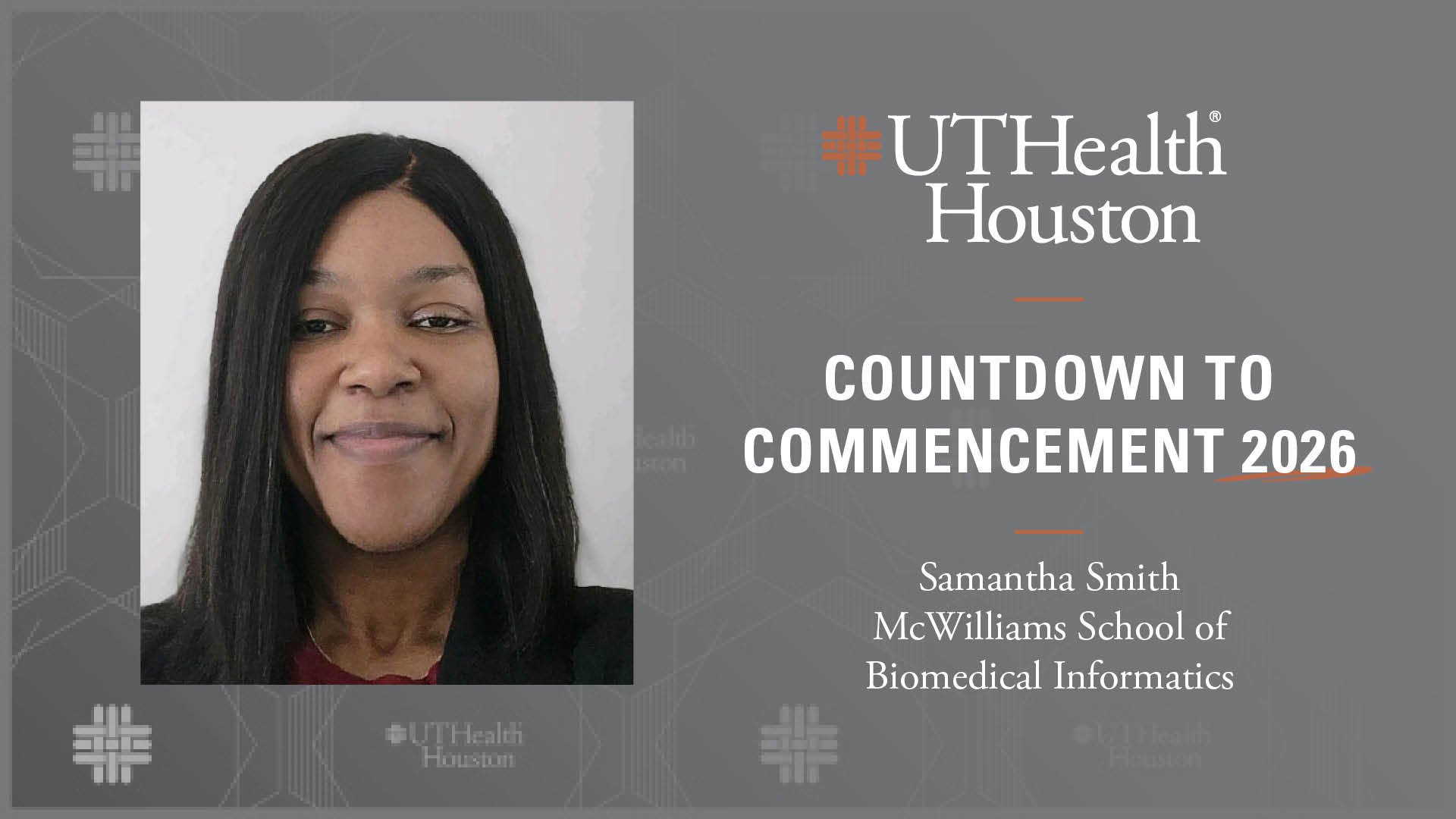
The path to biomedical informatics wasn’t something Samantha Smith always envisioned. Instead, it emerged from lived experience, one that reshaped her perspective on healthcare and ignited a passion for change.
“It was when I got sick with COVID,” Smith said. “I was having an issue transferring hospitals and seeing a lot of doctors at once.”
Already managing Type 1 diabetes, she was familiar with the healthcare system. However, navigating it during a crisis revealed something deeper.
“Even then, just getting my information from one place to another was a hassle. I wondered, What is actually wrong? What’s happening? And why is information not able to be easily sent from one place to another?”
That moment of frustration became the foundation of her future and would lead her to McWilliams School of Biomedical Informatics at UTHealth Houston.
Finding a path forward
Smith’s journey to graduate school came during one of the most difficult periods of her life. After becoming severely ill with COVID-19, she lost her job and faced new physical challenges.
“I became disabled. I was in and out of the hospital,” she said. “I had already stopped myself from going to grad school because I needed to work.”
Encouragement to continue came from her best friend. “He said, ‘Just go for it.’”
That push led her to explore programs in the Texas Medical Center, where she discovered a path that aligned with both her interests and career goals.
“I was specifically looking for something with Epic Analytics.”
She began a certificate program at McWilliams School of Biomedical Informatics before transitioning into graduate studies, setting the stage for a new chapter.
Understanding the system behind the care
Once in the program, Smith found herself drawn not just to the technical side of informatics, but to the complex systems that shape patient care.
“What surprised me most was learning all the ins and outs and the legalese around what is happening with interoperability,” she said.
She began to see the hurdles that exist behind the scenes, which were the same obstacles she had experienced firsthand as a patient.
“I didn’t think about the different barriers that are being encountered from different laws and regulations. And that really did surprise me.”
Using data to make a difference
Smith’s work centers on a simple but powerful goal: helping patients better navigate their care.
“I am interested in helping patients be able to take care of themselves and be able to go to the doctor,” she said. “My focus is on being able to use the data that’s in Epic to help people.”
Through her practicum and volunteer work, Smith has focused on leveraging data to improve outcomes, particularly for underserved populations. Working with Harris Health System, she contributes to programs that monitor chronic conditions, like diabetes, and address social determinants of health.
Her work includes analyzing trends in patient behaviors, such as emergency room visits, missed appointments, and access to resources such as transportation and internet connectivity.
Growth at a deeper level
Throughout her time as a student, Smith has gained more than technical knowledge. She has developed a deeper understanding of teamwork and the complexity of healthcare systems.
“It’s never just one person’s effort,” she said. “I was amazed by how many different pieces are needed to move together to help patients in the end.”
Courses in project management helped her see how collaboration drives patient outcomes.
A milestone worth celebrating
As Smith approaches graduation, the moment carries profound meaning—not just for her, but for her family.
“I’m the only person in my family who will have a master’s degree,” she said. “So, I know it’s really important to everyone.”
Reflecting on her experience, Smith is both grateful and optimistic about what lies ahead.
“I’m very fortunate. I’m very grateful that I chose this program. And I’m excited for what the future holds.”
Opportunities like volunteering with Harris Health and co-authoring a research paper have given her real-world experience and confidence moving forward.
Advice for the next generation
For students following in her footsteps, Smith offers advice grounded in her own journey.
“Reach out to people,” Smith said. Emphasizing the importance of community, especially for first-generation and underrepresented students.
“You cannot do it by yourself. You might be the only person writing the paper, but you still need somebody with you to say, ‘Hey, it’s been six hours. Have you eaten?’”
Finding balance along the way
Outside of academics and work, Smith finds ways to recharge through creativity and self-care.
“Music is very calming for me,” she said. “I use it when I paint.”
She also enjoys making press-on nails and exploring new restaurants, small moments that provided balance while she was on her educational journey.
From navigating illness to transforming systems of care, Samantha Smith’s story is one of perseverance, purpose, and impact—proof that even the most challenging experiences can inspire meaningful change.